

Every property insurance claim comes down to proof: what happened, what was damaged, and what the covered loss costs.
The “Proof of Loss” document is the cover sheet for that proof.
This guide walks you through the whole job: finding the rule that applies to your claim, assembling the evidence, reading the form, submitting it, and following up. A careful proof of loss can give your insurer a clear, organized account of what you're claiming. It cannot guarantee how much the insurer will pay or how fast the claim will end.
If the form is already in your hand, start here: first find the request and the policy's “Duties After Loss” section. Then identify the required form, the event that starts the deadline, who must sign, and where it must go. Calendar that deadline, preserve the evidence behind every answer, and do not guess at a number just to fill a blank. The rest of this guide shows you how.
What Is A “Proof of Loss”?
A “proof of loss” — sometimes titled a “Sworn Statement in Proof of Loss,” or POL/SPOL — is a formal statement about the policy, property, loss, and amount claimed. Depending on the policy or governing program, you may have to sign it, swear to it, or use a particular form.
With that stuffy definition out of the way, here are the basics:
You buy insurance to protect covered property against covered loss.
When a loss happens, you notify the insurer and make a claim under the policy.
You support the amount you're claiming with the information and documents your policy and the applicable rules require.
That third job is where proof of loss lives. The form summarizes your position. Your estimates, inventories, photos, receipts, reports, and other records explain it.
It's reasonable to feel uneasy when a form asks you to swear to a dollar amount while walls are still open, estimates are changing, or damaged contents haven't all been counted. Don't let the form's small print turn the job into a mystery.
Start by finding the instructions that control your claim. Read the insurer's request and the policy's “Duties After Loss” section. If this is an NFIP flood claim, use the federal flood-policy instructions rather than assuming the rules for an ordinary homeowners claim apply. Then build the evidence behind each answer instead of guessing your way through the blanks.
A Friend or Foe For Policyholders?
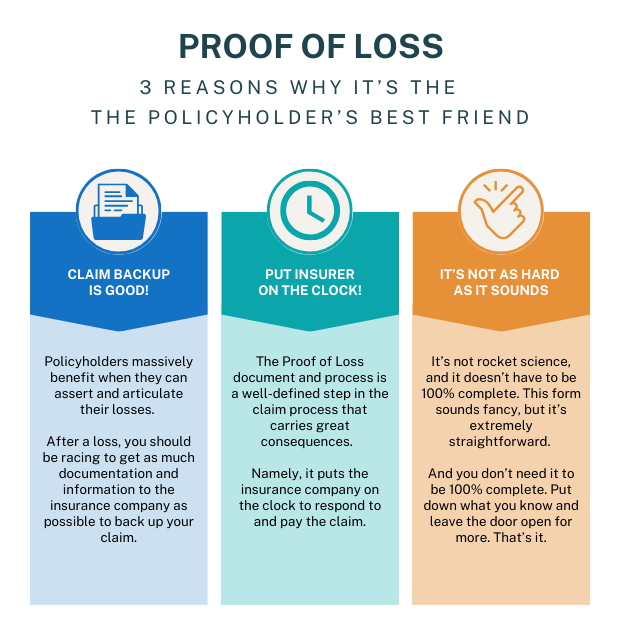
The proof of loss is neither automatically a trap nor automatically your ticket to payment. It's a serious claim document, and it can be a useful one when you treat it that way.
I disagree with the idea that fear is the right default. But I also wouldn't tell you that every claim needs a voluntary proof of loss or that no one ever needs professional help.
Here's the useful middle.
First, claim backup is good. A clear package forces you to identify what you're claiming and gives the insurer something concrete to evaluate. Send information promptly, but don't put yourself in danger, destroy evidence, or rush past an inspection requirement just to be quick.
Second, a formal proof can trigger duties under a policy, state rule, or federal program. Which duty starts — investigation, a coverage response, payment, or something else — depends on the actual rule. “It puts the insurer on the clock” is only useful advice when you know which clock.
Third, accuracy is not the same as certainty. Answer with what the evidence supports, say what you do not know, and follow the form and deadline that govern your claim.
Yes, a proof of loss can be a pitfall if you guess, miss the controlling deadline, or sign words you don't understand.
But for a well-informed policyholder, it can be a disciplined way to present the claim.
When Must A Proof Of Loss Be Sent? And Responded To?
There isn't one nationwide proof-of-loss deadline.
The policyholder's submission deadline may come from the policy, a carrier request, state law, or a federal program. The insurer's investigation, coverage-response, delay-notice, and payment duties may come from different provisions and start at different times. Case law can affect how a court treats a missed or defective submission, but it doesn't give you permission to ignore the written requirement.
| The policy or program: your submission clock | State or federal law: the insurer's clock | Cases and current law: the consequence |
|---|---|---|
| Find the required form, trigger, number of days, signature mechanics, delivery method, and extension rule. “After the loss” and “after our request” are different triggers. | Identify the exact duty: supply a form, investigate, accept or deny coverage, explain a delay, or pay an agreed amount. Do not treat those duties as interchangeable. | A defect's effect depends on the policy language, jurisdiction, facts, and current authority. Meet the written requirement when you can; get claim-specific advice when compliance is disputed. |
60 Days - Sending the POL
Sixty days is a real deadline in some proof-of-loss rules. It is not the deadline for every property claim.
California's statutory standard fire policy, for example, calls for a signed and sworn proof within 60 days after the loss unless the insurer extends that time in writing. The NFIP flood policy generally uses 60 days after the loss, with extensions made through the federal program. The Texas Windstorm Insurance Association's November 1, 2009 Dwelling Policy — Windstorm and Hail instead uses 91 days after TWIA requests a signed and sworn proof on its supplied form. That is a program- and edition-specific example, not a general Texas property-claim deadline.
The point isn't to memorize three numbers. It's to identify yours.
Start with the proof-of-loss request and the “Duties After Loss” section. Write down the event that starts the clock, whether the rule says calendar or business days, who must sign, whether a notary is required, which form must be used, and where it must go. If the deadline is close and you need more time, request an extension before it expires and keep the response. Don't assume a phone conversation, a cover-letter qualifier, or an adjuster's help changed the deadline.
Missing a required proof can jeopardize coverage or become part of a compliance dispute. The consequence isn't uniform, so neither extreme is safe: don't assume a late proof automatically ends every claim, and don't assume a court will excuse it.
30 Days - Approving the POL
Thirty days is also a real number in some claims rules, but “the insurer must approve the proof in 30 days” is not a national rule.
These rules may sit inside unfair-claims laws, but a missed deadline does not automatically give every policyholder damages, a penalty, or a private lawsuit. Enforcement and remedies are also state-specific.
The Wiggle Room: Case Law Shows Devil Is In The Details
The details matter, but “wiggle room” is not a strategy.
Courts do not use one nationwide rule to treat policyholder duties flexibly. They start with different policy language, state doctrines, and facts. A technical defect, a late submission, and a complete failure to submit aren't the same dispute.
Meet the rule in front of you. If the insurer says your proof is late, incomplete, or on the wrong form, ask for the exact policy provision and the specific defect in writing. Then get qualified help for the policy and jurisdiction if the answer could affect coverage.
Think “Proof of Loss” Package…Not Form
The form is a summary. The evidence explains the summary.
Proof-of-loss discussions often jump straight to blank-by-blank instructions. That makes the page look like the whole job. It isn't.
A beautiful form with no support leaves the insurer guessing how you reached the number. A strong package connects each important answer to something the insurer can inspect: an estimate, a room narrative, an inventory, a receipt, a report, or a photograph.
That doesn't make the technical form unimportant. Some policies and programs require a particular form, and a package without it may not satisfy the requirement. Think “package, not form” as the way to build the claim — then use the exact form the controlling instructions require.
Your task is to describe and support cause, scope, and cost accurately. The proof-of-loss form is the cover sheet for that work.
It’s Daunting – But You Don’t Need To Be Perfect!
You need to be accurate. You do not need to invent an answer for damage or cost that has not been established yet.
The right response to uncertainty is disclosure, not guesswork. Explain what the figure includes, what remains under investigation, and what documents support it. A qualifier can make the limits of your present knowledge clear; it cannot create a legal right to amend, replace a required form, or change a deadline.
Qualifying language can do three useful jobs:
Disclose that you aren't offering an expert opinion and identify which professionals or investigation you are relying on.
State the date and information on which the cause, scope, and cost figures are based, and name the areas that remain under investigation.
Identify estimates as estimates and describe the specific conditions that could change them, without claiming that the sentence guarantees a right to supplement later.
Da Vinci can sit this one out. Your job is to show what each figure rests on and where the investigation is still open.
Start With What You Have and Early Costs
Losses don't always reveal themselves all at once. You may have emergency work, temporary housing, or damaged contents to document before the full repair scope is known.
Start with what you can support. Protect people first, take reasonable steps required by the policy to prevent further damage, and do not discard damaged property or make extensive permanent repairs before the insurer has a reasonable opportunity to inspect when the policy or claim instructions require it.
| Item | What to record | Example supporting material |
|---|---|---|
| Emergency repairs | Work reasonably needed to protect people or prevent additional damage, while preserving evidence and following inspection instructions. | Contractor estimates and invoices; receipts; before-and-after photos. |
| Room-by-room narrative | Each affected room or area, the visible damage, and what remains hidden or unevaluated. | Written narrative; floor plans; dated voice notes transcribed into the claim file. |
| Before-and-after condition | The property's condition before the event and the damage afterward. | Personal photos; inspection/appraisal records; real-estate listing photos you are entitled to use. |
| Contents inventory | Each damaged item, its condition, and support for age, ownership, and value. | Inventory spreadsheet; receipts; account records; photographs; comparable-item support. |
| Loss of use | Additional living or operating expenses you actually incur and the reason for each one. | Hotel, storage, transportation, rental, and other receipts; written quotes for anticipated costs where the policy permits. |
Do not assume you can always file an incomplete proof now and fix it later. Instead, separate the evidence you can submit promptly from the formal proof requirement. If the policy or governing rule permits supplements, preserve what changed, the new support, the date sent, and the insurer's acknowledgment. If you need an extension, ask before the deadline.
Build Your Proof Castle: Cause, Scope, & Cost
Build your “Proof Castle” around three questions: What caused the damage? How far does it extend? What will covered repair or replacement cost?
The insurer may assign adjusters, engineers, or other professionals. Their reports can be useful, but their role depends on who retained them and for what purpose. Read the work, compare it with what you can see and document, and raise specific omissions instead of assuming the report either proves or defeats your claim.
| Category | Question to answer | Example supporting material |
|---|---|---|
| Cause | What event or combination of events produced the damage, and which causation questions remain open? | Weather records; photographs; qualified engineering or contractor opinions. |
| Scope | Which materials, rooms, systems, or contents are affected, and what work is reasonably necessary? | Measurements; code information; contractor/engineer/adjuster scopes and estimates. |
| Cost | What does the supported scope cost under the policy's valuation method and coverage terms? | Itemized estimates; invoices; receipts; qualified professional opinions. |
Cause, scope, and cost are the practical spine of the package. Coverage, policy duties, deductibles, limits, and valuation rules remain separate questions. The proof-of-loss page summarizes the supported position and contains the declarations the form actually requires.
Make the package easy for someone else to follow. Give every estimate, inventory, photograph set, and report a clear name and date. If a total on the form comes from several documents, include a short cross-reference showing where the pieces live. This isn't fancy claims theater. It is the difference between handing over a number and handing over a number the next adjuster can retrace.
Your Form or Theirs?
Use the form your controlling instructions require. If the insurer supplies one, read it against the policy and request before you sign.
When The Insurance Company Hands You Their Form

An insurer-supplied form may be a straightforward way to collect the information the insurer says it needs. It may also arrive near a proposed settlement or alongside other documents. Do not assume every page in the packet does the same job.
Read the title, every declaration above the signature, any release or settlement language, and the instructions for supporting documents. A proof of loss, a release, and a settlement agreement are different documents even when they arrive in one email.
Changing the carrier's form or substituting another one is not safe as a universal instruction. Some policies, state statutes, and federal programs require a supplied or prescribed form. If a line is inaccurate or impossible to answer, ask the insurer in writing how it wants the issue handled. If the answer could limit coverage or rights, get claim-specific legal advice before signing.
Taking the Initiative: Submit Your Own POL Form First
My advice is still to be proactive: don't wait until the last minute to organize your proof. Whether you should submit your own form before the insurer asks is a separate question. Verify the policy, governing program, form requirement, deadline, and supplement rule first.
If an alternative form is permitted, it has three jobs:
Cover the essentials. Include the policy, property, claim, loss, interests, values, and declarations the controlling requirement calls for.
Describe uncertainty accurately. State what the figures are based on and what remains unknown. Do not claim that a qualifier guarantees amendment rights.
Ask for specific objections in writing. Invite the insurer to identify missing information or a required form. That request creates a useful communication record; it does not prove legal compliance by itself.
Examining Different Forms from Different Companies
Carrier forms vary, which makes side-by-side review useful. Compare the fields, declarations, deadline, signature mechanics, and requested attachments against the policy and request.
Filling Out The Proof of Loss: A Field-By-Field Guide

A blank proof-of-loss form is easier to read when every answer has a source. Match each field to the policy, claim record, estimate, title record, or other document that supports it, and flag any field you cannot answer accurately.
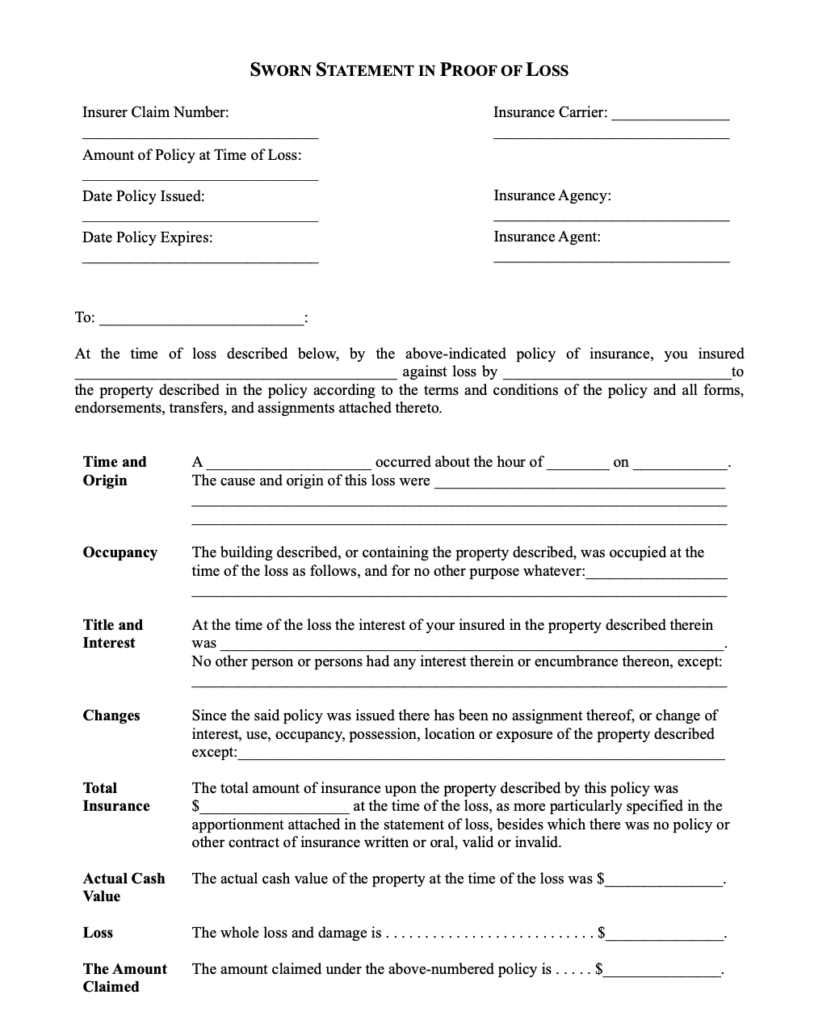
This field guide organizes the job into four practical parts. The Brelly PDF associated with this guide does not label these four groups, and other forms may differ:
Capture the basics. Identify the insured, insurer, policy, claim, property, and loss.
Establish property interests. Identify ownership, mortgage, occupancy, or other interests the form requests.
Quantify the loss. State values and amounts using the policy's coverage and valuation rules, not a shortcut formula.
Sign and swear as required. Read every declaration and follow the actual signature, oath, witness, or notary instructions that apply.
That's the map. The table below is a cross-form checklist, not an exact inventory of that Brelly PDF. It visibly asks for insurer and claim information; policy dates and amounts; insurance agency and agent information; insured, occupancy, ownership, and other-insurance details; loss date, time, and cause; changes in title, interest, use, location, or exposure; and value, whole- loss, and amount-claimed figures. It does not separately label every row below—for example, property address, policy number, mortgagee, and deductible are not separate visible fields.
If you're scanning, the table runs from policy basics through property interests, then loss facts, then valuation and the amount claimed. Now take the fields one at a time.
| Proof-of-loss field | What to verify before answering |
|---|---|
| Insurer | The legal name of the insurance company shown on the policy, not merely the agency or adjuster's company. |
| Policy number | The number on the policy and declarations for the coverage involved. |
| Policy issue / expiration date | The effective dates shown in the controlling policy documents. Do not assume the term is one year. |
| Policy amounts | The applicable limits or amounts shown by coverage. A limit is not necessarily the amount payable for the loss. |
| Other / total insurance | Any other insurance the form asks you to disclose. Do not enter No or $0 merely because you are unsure; check your records or ask for qualified help. |
| Property address | The insured location requested by the form; some documents call it the risk address. |
| Property type / occupancy | How the property was actually used or occupied at the relevant time, using the form's terms where accurate. |
| Property owner | The legal owner or owners requested by the form. Check title or other reliable records instead of assuming. |
| Mortgagee(s) | Any lender or other mortgage interest the form asks you to identify. Use the current policy and loan records. |
| Changes | Any requested change in title, interest, use, occupancy, possession, location, or exposure. Do not default to “none” without checking the exact question. |
| Claim number | The number assigned by the insurer, if one has been assigned. If not, ask how the form should show that fact. |
| Date of loss | The date the covered event occurred or, for an uncertain or continuing loss, the date supported by the facts and claim instructions. |
| Time of loss | The supported time or an accurate statement that it is unknown, if the form permits that response. |
| Cause of loss | The event or events supported by the evidence. Wind, water, flood, fire, theft, and other causes can implicate different coverage; do not select a cause merely because it appears on a generic list. |
| Actual cash value | The amount calculated under the policy and applicable valuation rule. ACV often accounts for depreciation, age, or wear, but methods vary; it is not simply a casual guess at sale price. |
| Loss amount | The amount supported for the loss category the form is asking about, subject to scope, valuation, and coverage. Do not assume every repair or expense belongs in one total. |
| Deductible amount | The deductible that applies to the claimed coverage and event. It may be a fixed amount or calculated under policy terms. |
| Amount claimed | The amount claimed under the policy after applying the calculation the form and coverage require. It may involve more than loss minus deductible, including limits, depreciation, prior payments, sublimits, or other interests. |
The Brelly PDF also contains declarations above the signatures. Read the actual form in front of you; these blocks aren't universal:
Fraud and accuracy language. The form may ask you to certify that the information is true and that you haven't knowingly concealed or misstated material facts. An innocent mistake and intentional material fraud are not the same thing, but errors should be corrected promptly.
Subrogation language. Some policies or forms address the insurer's recovery rights against a responsible third party after payment. Do not translate this into “you release all rights.” The Brelly PDF does not visibly contain a subrogation paragraph.
No-waiver language. A form may say that furnishing the blank or helping prepare it does not waive the insurer's policy rights.
Signature and oath language. Follow the form's actual signature, knowledge-and-belief, sworn-statement, witness, and notary requirements. Not every proof uses the same mechanics.
Best Practices for Submitting Your Proof of Loss
The best delivery method is one the controlling instructions accept and you can prove.
Claims communication can sprawl across email, portals, calls, letters, and changing adjusters. Before you submit, save a complete copy of the exact form, cover letter, and every attachment. Name the files clearly enough that you can reconstruct the package later.
Then follow the delivery instructions. If the insurer accepts portal or email delivery, preserve the upload confirmation or sent message and attachments. If the policy or insurer requires mail, use a trackable service and preserve the receipt. A belt-and-suspenders second channel can help only if both channels are accepted and the duplicate won't create confusion.
Certified mail isn't magic, and no paper trail is “indisputable.” What matters is being able to show what you sent, when, how, and to whom — plus any acknowledgment or objection you received.
Deadlines & Next Steps: What to Do After Submitting Your Proof of Loss
Submitting the form is a milestone, not the finish line.
Record the delivery date and the rule you believe it triggers. Watch for acknowledgment, requests for missing information, an acceptance or denial, a delay explanation, and payment activity. Keep those events separate so one response doesn't get mistaken for another.
Mind The Deadlines & Followup If Missed
Calendar the actual deadline that applies, not a generic 30-day reminder.
Brelly's state guides can help you identify state-specific rules, but they do not supply one universal proof-review deadline, and they cannot override the policy or a federal program.
If a response appears late, ask for status in writing. Identify the proof, delivery date, claim number, and the provision you believe applies. Ask the insurer to explain any missing information, extension, or reason for delay. Preserve the response.
That follow-up creates a clear record. It does not automatically put the insurer “in default” or create a penalty. Those consequences depend on the policy, state law, remedy, and facts.
Supplement Your Proof
Supplement only when the controlling policy or rule allows it, and make the update easy to audit.
New information may emerge: hidden damage becomes visible, a contractor revises a scope, or a contents inventory gets better support. Do not assume a later form automatically cures the first one. Confirm the process, identify exactly what changed, attach the supporting material, and keep delivery and acknowledgment records.
Louisiana's 2025 statute expressly contemplates amounts known to date and supplemental loss in its commissioner-approved form framework. The statute took effect August 1, 2025, but its application to a particular earlier policy, loss, request, or pending claim still needs claim-specific review. It is not a national amendment rule. NFIP flood claims and private policies may use different requirements.
Escalate the Claim
Escalate when an ordinary written follow-up doesn't resolve a material issue — and match the professional to the problem.
A licensed public adjuster may help prepare and present a property claim within the role allowed by state law. A lawyer is the right person for legal interpretation, a disputed condition, or a rights question. Licensing, contracts, and fees vary by state and circumstance. Florida, for example, uses different public-adjuster fee limits depending on emergency status, timing, and the payment stage; California requires public-adjuster contract disclosures, including compensation.
Before hiring anyone, verify the license, read the compensation and cancellation terms, understand who will do the work, and know what problem you are paying them to solve.
Top DOs & DONTs For Handling The Proof of Loss
DON'T falsify or inflate. Be accurate, disclose uncertainty, and correct mistakes. A knowing, material falsehood can carry serious policy and legal consequences; that does not mean every innocent mistake automatically voids the entire claim.
DO handle the requirement. If your policy, insurer, state rule, or federal program requires a proof of loss, identify the form and deadline and get the work moving. A proactive voluntary proof can be useful in some claims, but it is not a universal move for every claim.
DON'T blindly sign. Read the declarations and distinguish the proof from any release, settlement, assignment, or other document in the packet. If you don't understand the effect of the words above your signature, stop and get the right help.
DO request time and describe uncertainty accurately. Ask for an extension before the deadline and preserve the response. Use qualifiers to tell the truth about what is known today, not to pretend you have a guaranteed right to change the proof later.
DON'T forget the backup. The form states the position; the package shows the work. Keep a copy of every estimate, inventory, photograph, receipt, report, cover letter, delivery record, and response that supports the claim.
