
New to insurance claims and need a primer on insurance adjusters and who they work for? Here’s a quick explainer on property insurance adjusters.
Who are insurance adjusters and what do they do?
An adjuster is a professional who investigates an insurance claim and helps document and evaluate what happened. For a property claim, that usually comes down to two basic tasks.
First, they inspect and document your property damage to understand the nature and scope of your loss. That may include taking measurements and photographs, reviewing the claim and policy, and asking for records related to the damage.
Second, they prepare or evaluate the scope and amount of the loss using the inspection and any additional documentation you provide. Depending on the adjuster’s role, that can mean preparing an estimate, evaluating one, or presenting and negotiating the claim. The insurer—not every individual adjuster—makes the final coverage and payment decision. These general tasks are reflected in the NAIC’s adjuster guidance, although the exact workflow depends on the policy, claim, role, and state.
Your documentation and the inspection work together. Show the adjuster all known damage, share relevant photographs, inventories, receipts, and repair records, and answer questions accurately. If you don’t know an answer, say so and follow up rather than guessing.
The scope and estimate matter because they help shape the insurer’s payment decision.
What are the different types of property insurance adjusters?
For now, focus on three main roles: company or staff adjusters, independent adjusters, and public adjusters. States use other credential and specialty labels, so these aren’t the only titles you’ll see.
Company adjusters, also known as staff adjusters, are employees of an insurance company or its affiliate and handle claims for the insurer. Independent adjusters, confusingly, also work on assignments for insurance companies—only instead of working as an employee of the assigning insurer, they work through an independent adjusting business or contract relationship. They may receive work from one or more insurers, but having multiple insurer clients is not what defines the role.
Public adjusters, by contrast, are hired by policyholders under a contract to help prepare, present, or negotiate their claim. Compensation and contract rules vary by state, as California’s statute and Florida’s consumer guidance illustrate, so review the agreement before signing. To learn more about fees, services, and hiring a public adjuster, check out our explainer on public adjusters.
So from the perspective of a homeowner, the important distinction is between company or staff adjusters and independent adjusters, both of whom work on the insurer’s side of the claim, and public adjusters, who are retained and paid under contract by policyholders. The NAIC’s national orientation, California’s required disclosure, and Florida’s public-adjuster definition all support that basic alignment, even though state details differ.
What is the difference between independent adjusters and public adjusters?
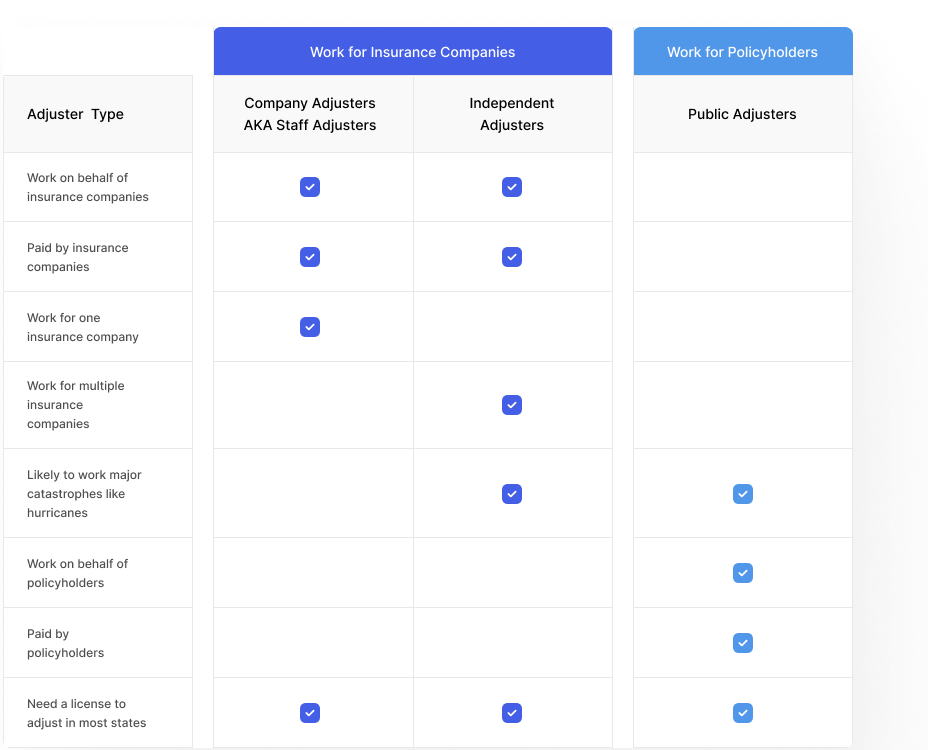
“Independent” describes the adjuster’s relationship to the insurer’s payroll. It does not mean the adjuster is a neutral third party or someone the policyholder hired.
The work may look similar—both may inspect damage, prepare a scope, review an estimate, and discuss the claim. The table below shows the employer and payment differences.
Still confused? The chart below helps to clarify the differences between adjusters.
| Comparison | Company/staff adjuster | Independent adjuster | Public adjuster |
|---|---|---|---|
| Who they work for | The insurer or an insurer affiliate | The insurer assigning the work | The policyholder who hires them |
| Who pays them | The insurer or affiliate as an employee | The insurer or adjusting firm through the assignment relationship | The policyholder under the public-adjuster contract; the permitted method varies by state and contract |
| Work relationship | Insurer staff or affiliate employee | Separate adjuster or adjusting firm working under contract; may receive assignments from one or more insurers | Contracted by the policyholder to prepare, present, or negotiate the claim |
Catastrophe and credential caution: Company/staff and independent adjusters may handle catastrophe losses; public adjusters may work for policyholders after a catastrophe. Independent adjusters may also work through state-specific emergency pathways. The role itself does not predict who will handle a particular loss. Licensing or other credential requirements vary by state and role, and some states take materially different approaches.
Table sources: NAIC State Licensing Handbook, Chapter 18, NAIC’s state-by-state licensing chart, California Insurance Code § 15027, and Florida’s definitions of public, independent, and company employee adjusters.
Do adjusters need a license?
It depends on the state and the adjuster’s role. States license, exempt, appoint, register, or otherwise authorize different kinds of adjusters in different ways. For example, Florida licenses company and independent adjusters, while California’s required disclosure says company adjusters are not licensed by the state. The NAIC’s licensing chart shows how much the categories and exceptions vary, but the relevant state insurance department is the authority for your claim.
Alabama shows why a simple yes-or-no answer falls apart. The Alabama Department of Insurance says the state does not license or recognize public adjusters. That is a different state approach, not a nationwide licensing rule.
During declared catastrophes, some states activate temporary licensing, registration, or emergency-adjuster pathways. These are not automatic, nationwide license waivers. They can involve a state declaration, insurer or firm sponsorship, registration, fees, limits, and an expiration date.
In Florida, for instance, an otherwise unlicensed person may be designated and certified to the Department of Financial Services by an insurer or qualifying adjusting firm. The department may then issue a temporary emergency license subject to the state’s conditions and duration. The insurer or firm certifies the person; it does not issue the license. See Florida Statutes § 626.859 and § 626.874.
The practical tradeoff is speed versus verification. A temporary pathway can get more adjusters authorized after a catastrophe, but the credential category alone tells you nothing reliable about the quality of an adjuster’s work. Verify the person’s identity and authority, keep your own records, and ask about damage that appears to be missing from the scope or estimate.
Florida also allows a licensed and appointed insurance agent to adjust losses for the insurer the agent represents when that insurer authorizes the agent to do so. That is a narrow exception, not permission for any agent to adjust any claim. See Florida Statutes § 626.862.
How can I verify that my adjuster is properly licensed or registered?
Ask the adjuster for their full name, role, employer or firm, and license or registration number where one applies—ideally before the inspection begins. Ask them to provide those details in writing when possible. You may not have a universal legal right to a particular proof document, and some staff roles are exempt from individual licensing, but you can still ask who the person is and what authority they are working under.
Then verify the information with the state regulator:
- Find your regulator through the NAIC directory of state insurance departments.
- Use the state’s official license lookup, if the role is individually licensed there. Search by name or license number and confirm that the license type matches the role the person gave you.
- If nothing appears, check the spelling and role, then contact the regulator or insurer. A failed search is a reason to ask questions—not proof of fraud.
Florida has a more specific rule for claims handled by a residential property insurer. When that insurer’s investigation includes a physical property inspection, the licensed adjuster assigned by the insurer must give the policyholder a printed or electronic document with the adjuster’s name and state license number. Separately, later claim communications must include the name and license number of the adjuster communicating about the claim. These are insurer-side duties; they do not apply to public adjusters. See Florida Statutes § 627.70131(3).
If an estimate appears to leave out damage or use the wrong quantity, quality, or price, ask for the scope or detailed estimate and point to the specific item with photographs, receipts, contractor documents, or other relevant records. Ask for a written explanation. If the disagreement remains, follow the next step in your policy or contact your state insurance department; options such as appraisal depend on the policy and generally concern the amount of loss, not a coverage dispute.
