15 DAYS: Make the Claim
A Texas insurer must begin investigating a claim within 15 calendar days of receiving a written notice of loss. Major natural disasters may extend this deadline by 15 calendar days.
Fact checked by Brelly Legal TeamLast updated on April 18, 2025
They say everything’s bigger in Texas, and that certainly holds true for the thicket of laws, rules, and deadlines surrounding property insurance claims in Texas.
Fear not. Our Texas Guide to Property Insurance Claims will break down and simplify the most important information you need to know about Texas laws so you can get the claim paid fully, fairly, and fast. We cover key deadlines that every policyholder and professional should know. We also provide FAQs that address some of your most pressing insurance claim questions. And we round it out with a curated list of important Texas statutes and regulations related to property insurance claims.
Note: This guide covers Texas property claims — not auto, health, disability, liability, or other types of claims. But for homeowners claims, condo claims, commercial property claims, and any other claim for covered property in Texas, this is your go-to resource for claims help.
If you’re dealing with an insurance claim, you’ve got questions — probably lots of questions. The good news is that we’ve got answers. Written by insurance-law experts, these FAQs will help you navigate the confusing landscape of insurance-claim deadlines and laws in Texas. They’re specific to property claims, but they generally apply regardless of whether you’re a homeowner, business, or professional.
The first step in a property insurance claim is to notify the insurer about the loss. Not only is doing this the only way to get a claim moving, it’s one of the policyholder’s duties after a loss under the insurance policy.
In Texas, the deadline to file a property insurance claim like a homeowners or commercial property claim is stated in the insurance policy, which in most cases requires prompt notice.
Some states, like Florida, have passed statutes that set strict deadlines for filing property insurance claims (for example, one year from the date of loss). Texas is not one of those states, so the deadline to file a claim in Texas is determined by the insurance policy, not statute.
Many insurance policies require the policyholder to make a claim promptly after the loss to the home or business is discovered.
What does it mean to “make a claim”? It simply means notifying the insurance company about loss or damage to covered property. This initial notice triggers the claims process and counts as “filing a claim” — or what the insurance companies call a First Notice of Loss (FNOL).
What counts as a “prompt” notice? Well, it depends on the circumstances of the loss, but a good rule of thumb is that you should notify the insurance company about a loss as soon as you know that the losses will exceed the deductible. Don’t delay! The longer you wait to file your claim, the longer it will take to resolve the claim. Waiting too long to file the claim could also cause important evidence about your claim to deteriorate.
Probably not, but you should make your claim in writing.
Texas statutes do not mandate that policyholders use any specific form when making a claim. Likewise, most insurers do not require a specific form for making a claim, although they may require a specific form when submitting a Proof of Loss (more on that later). If the insurance company does want you to complete a specific form when making a claim, Texas Insurance Code Section 542.055(a)(3) requires the insurance company to specify and provide exactly what forms it wants.
In any event, it’s critical for policyholders in Texas to make their claim in writing. That’s because technically, only claim notices made in writing trigger the insurance company’s deadlines under Section 542.055(a) to begin investigating and processing a claim. In practice, people initiate claims over the phone all the time, but it’s better to be safe than sorry. So if you make your claim over the phone, you should absolutely follow up with an email confirming that you’ve notified your insurer about your claim.
Often yes!
Most insurance companies will quickly reimburse policyholders for certain types of expenses. Good examples are emergency repairs, debris cleanup, and additional living expenses (ALE). For these types of expenses, you should submit for reimbursement at your first opportunity. If keeping track of expenses and receipts is a chore you’d rather avoid, consider using the Expense Builder in our Claim Manager to streamline the process.
Some states, like Louisiana and California, have enacted laws that require insurance companies to provide additional living expense payments under certain circumstances. Although Texas is not one of those states, you should check your policy to see if you qualify for ALE reimbursements.
Unless it’s an eligible surplus lines carrier, a Texas insurance company must acknowledge a claim within 15 calendar days* of receiving a written notice of loss.
Eligible surplus line carriers must acknowledge a claim within 30 business days* of receiving a written notice of loss. “Business days” means Monday-Friday, excluding holidays recognized by the state of Texas.
*The Texas Insurance Commissioner may extend these deadlines by 15 calendar days if it determines that a weather-related event qualifies as a catastrophe under Insurance Code Section 542.059.
Yes! The Texas Department of Insurance has published a consumer bill of rights for homeowners, dwelling, and renters insurance. It’s a handy way to better understand your rights in all aspects of the insurance process, not just claims.
After you’ve notified your insurance company and started the claim, you need to prove the losses to the insurance company. Proving that the property suffered losses and that those losses are covered under the insurance policy is at the heart of an insurance claim. As a result, it’s also the most difficult stage in the claims process and where policyholders most often make mistakes. Fortunately, Texas laws do provide you with basic protections at this stage under the Texas Prompt Payment of Claims Act. Read more to understand how.
Unless it’s an eligible surplus lines carrier, a Texas insurance company must begin investigating a claim within 15 calendar days* of receiving a written notice of loss.
Eligible surplus line carriers must begin investigating your claim within 30 business days* of receiving your written notice of loss. “Business days” means Monday-Friday, excluding holidays recognized by the state of Texas.
*The Texas Insurance Commissioner may extend these deadlines by 15 calendar days if it determines that a weather-related event qualifies as a catastrophe under Insurance Code Section 542.059.
In Texas, an insurance company is required by law to inform the claimant which documents will be needed to prove the loss and pay the claim within 15 calendar days* of receiving the written notice of loss (30 business days* for surplus lines). Insurance Code §§ 542.055 and 542.056.
One common document that you may need to submit to the insurance company is called a sworn statement in proof of loss (often just called a proof of loss or POL). A proof of loss is a powerful tool for moving claims forward because it elevates the weight of evidence behind your claim and puts the ball in the insurer’s court to respond. Although a proof of loss isn’t needed on every claim, it can be very helpful for larger or more complex claims. For these claims, we think the best practice is to send a POL even when your carrier doesn’t require it.
Want to submit a proof of loss? We offer a free form POL for download.
*The Texas Insurance Commissioner may extend these deadlines by 15 calendar days if it determines that a weather-related event qualifies as a catastrophe under Insurance Code Section 542.059.
The insurance policy should state if and when you need to submit a proof of loss.
Texas law does not set a specific deadline to file a proof of loss. Most insurance policies, however, require you to file a proof of loss between 30-60 days from when the insurance company requests it. Follow whatever deadline is stated in the policy. Failing to do so may jeopardize the entire claim.
Regardless of the deadline in your policy, you should submit a proof of loss as soon as possible. Generally speaking, the sooner you submit that form, the sooner you’re likely to get an insurer to respond to the claim and then hopefully get paid.
For first-party property claims, 15 business days from when “the insurer receives all items, statements, and forms required by the insurer . . . .” Insurance Code § 542.056. “Business days” means Monday-Friday, excluding holidays recognized by the state of Texas.
The insurance company should notify the claimant in writing whether it is accepting or denying the claim, and any denial requires a written explanation.
There are a few important exceptions for this deadline:
So for major natural disasters, the timeframe to accept or deny your claim could be as long as ~80 days from when your insurance company has received all documents needed to prove your claim (15 business-day deadline + 45 calendar-day insurer extension + 15 calendar-day natural-disaster extension).
No, Texas Insurance Code section 541.060(a)(7) prohibits an insurance company from “refusing to pay a claim without conducting a reasonable investigation with respect to the claim.” Violation of section 541.060(a)(7) is subject to enforcement action by the Texas Department of Insurance and gives rise to a private right of action (lawsuit) if it causes actual damages. Texas Ins. Code § 541.151.
Getting the money you need to put the property back in order — it’s the reason a policyholder pays premiums. Below are answers to frequently asked questions about this crucial final steps in the insurance claim.
For non-disaster claims, it’s 60 calendar days from when the insurance company receives a proof of loss or any other documents it reasonably requests from the policyholder. For natural disaster claims, the deadline can extend to 75 days. Insurance Code § 542.058.
In addition, once a Texas insurance company agrees to pay a claim, it has 5 business days* to actually tender payment, unless the insurer is a surplus lines carrier. The deadline for a surplus line carrier to pay is 20 business days* from when it gives notice of accepting the claim. Insurance Code § 542.057. “Business days” means Monday-Friday, excluding holidays recognized by the state of Texas.
If payment is explicitly conditioned on the policyholder taking a specific action (for instance, signing a formal settlement agreement or submitting a proof of loss), then the clock does not begin to run on these deadlines until that action occurs.
*The Texas Insurance Commissioner may extend these deadlines by 15 calendar days for major natural disasters.
Yes. In Texas, if an insurance company accepts a claim in part, then it must pay that part of the claim within the 5/20 business-day deadlines described above and set by Insurance Code section 542.057.
The short answer is fees and penalties.
Under Texas law, failing to abide by the state’s claim-handling deadlines entitles a claimant to sue the insurance company for statutory interest and attorney’s fees, in addition to whatever other claims the claimant may have. Insurance Code § 542.060. Not all states allow a claimant to sue when the insurance company doesn’t meet statutory claim-handling deadlines. But Texas is not one of those states. The availability of attorney’s fees is an especially powerful tool for claimants.
In some cases, your insurance company may be required to send property claim payments to the lender that has a mortgage or deed of trust on your home. Your lender may also have the right to hold onto that payment until repairs on your home are complete. If this happens, Texas law gives you important rights that the lend must comply with.
First, within 10 days of receiving the insurance money, your lender must:
(a) notify you that it received the money, and
(b) tell you what you must do before the money can be released, if applicable.
Also, within 10 days after you ask your lender to release payment, your lender must:
(a) release the money to you, or
(b) explain any unfulfilled requirements for releasing payment.
If your lender does not provide the notices mentioned above or pay the money after all the requirements have been met, the lender must pay you 10% interest on the improperly withheld money.
Yes. As part of the 2023 legislative session, the Texas legislature enacted a law that guarantees the right of a policyholder to engage a public adjuster.
Specifically, section 4102.007 of the Texas Insurance Code prohibits a homeowners policy, commercial property policy, or any other commercial or residential property insurance policy from barring the policyholder from engaging the services of a public adjuster licensed to practice in the state of Texas.
Yes, Texas has a well-developed system for filing insurance complaints. Texas statutes also require state regulators to take complaints about property claims seriously. To file a complaint, start by going to the Texas Department of Insurance webpage for homeowners and renters insurance complaints.
In Texas, the deadline to sue an insurance company for failing to properly pay a claim is usually two years from when the insurance company first wrongly denies the claim. See, e.g., Rodriguez v. State Farm Lloyds, cv. 5:17-CV-161 (S.D.Tx 2018).
A policyholder or other claimant suing an insurance company might bring two or more different legal claims against the insurer, such as Texas Insurance Code and/or breach of contract. Although the statute of limitations (deadline to sue) is two years for violating the Texas Insurance Code and four years for a breach of an insurance policy, Texas law allows policies to include language limiting the deadline to sue to two years and a day. Granger v. Travelers Home & Marine Ins. Co., No. 04-17-00814-CV (Tex. App. Dec 12, 2018). So for most policyholders, the deadline to sue the insurance company is two years from when the insurance company first improperly denies the claim.
One important note here: The trigger for this deadline – wrongful “denial” a claim – could take on different forms. It could mean an explicit denial letter, but it also could mean an insurer “ghosts” you and fails to pay without any explanation or an explicit denial. In other words, the insurer doesn’t have to say the magic word “deny” to trigger the counting of the 2-year statute of limitations in Texas.
Like most states, Texas has a large collection of laws applicable to the insurance claims process for property owners. Here is a selection of relevant statutes that will help you with the process, all housed within the Texas Insurance Code.
“Notice of claim” means any written notification provided by a claimant to an insurer that reasonably apprises the insurer of the facts relating to the claim.
(a) Except as provided by Subsection (b), an insurer to whom this chapter applies shall deliver a policy issued by the insurer to the policyholder, or to the insurer’s agent for delivery to the policyholder:
(1) not later than:
(A) the 30th day after the effective date of the policy if the policy term is more than 30 days; or
(B) the 10th day after the effective date of the policy if the policy term is more than 10 days and less than 31 days; or
(2) within the policy period for a policy with a term of 10 days or less.
(b) An insurer to whom this chapter applies shall deliver a policy renewed or amended by the insurer to the policyholder, or to the insurer’s agent for delivery to the policyholder, not later than the 15th day after the date the insurer or insurer’s agent receives a written request from the policyholder that the policy be delivered to the policyholder.
[The Texas Prompt Payment Act, Ins. Code Sections 542.051 – 542.061] shall be liberally construed to promote the prompt payment of insurance claims.
(a) Not later than the 15th day or, if the insurer is an eligible surplus lines insurer, the 30th business day after the date an insurer receives notice of a claim, the insurer shall:
(1) acknowledge receipt of the claim;
(2) commence any investigation of the claim; and
(3) request from the claimant all items, statements, and forms that the insurer reasonably believes, at that time, will be required from the claimant.
(b) An insurer may make additional requests for information if during the investigation of the claim the additional requests are necessary.
(c) If the acknowledgment of receipt of a claim is not made in writing, the insurer shall make a record of the date, manner, and content of the acknowledgment.
(a) Except as provided by Subsection (b) or (d), an insurer shall notify a claimant in writing of the acceptance or rejection of a claim not later than the 15th business day after the date the insurer receives all items, statements, and forms required by the insurer to secure final proof of loss.
(b) If an insurer has a reasonable basis to believe that a loss resulted from arson, the insurer shall notify the claimant in writing of the acceptance or rejection of the claim not later than the 30th day after the date the insurer receives all items, statements, and forms required by the insurer.
(c) If the insurer rejects the claim, the notice required by Subsection (a) or (b) must state the reasons for the rejection.
(d) If the insurer is unable to accept or reject the claim within the period specified by Subsection (a) or (b), the insurer, within that same period, shall notify the claimant of the reasons that the insurer needs additional time. The insurer shall accept or reject the claim not later than the 45th day after the date the insurer notifies a claimant under this subsection.
(a) Except as otherwise provided by this section, if an insurer notifies a claimant under Section 542.056 that the insurer will pay a claim or part of a claim, the insurer shall pay the claim not later than the fifth business day after the date notice is made.
(b) If payment of the claim or part of the claim is conditioned on the performance of an act by the claimant, the insurer shall pay the claim not later than the fifth business day after the date the act is performed.
(c) If the insurer is an eligible surplus lines insurer, the insurer shall pay the claim not later than the 20th business day after the notice or the date the act is performed, as applicable.
(a) Except as otherwise provided, if an insurer, after receiving all items, statements, and forms reasonably requested and required under Section 542.055, delays payment of the claim for a period exceeding the period specified by other applicable statutes or, if other statutes do not specify a period, for more than 60 days, the insurer shall pay damages and other items as provided by Section 542.060.
(b) Subsection (a) does not apply in a case in which it is found as a result of arbitration or litigation that a claim received by an insurer is invalid and should not be paid by the insurer.
(c) A life insurer that receives notice of an adverse, bona fide claim to all or part of the proceeds of the policy before the applicable payment deadline under Subsection (a) shall pay the claim or properly file an interpleader action and tender the benefits into the registry of the court not later than the 90th day after the date the insurer receives all items, statements, and forms reasonably requested and required under Section 542.055. A life insurer that delays payment of the claim or the filing of an interpleader and tender of policy proceeds for more than 90 days shall pay damages and other items as provided by Section 542.060 until the claim is paid or an interpleader is properly filed.
(a) A court may grant a request by a guaranty association for an extension of the periods under [the Texas Prompt Payment Act, Ins. Code Sections 542.051 – 542.061] on a showing of good cause and after reasonable notice to policyholders.
(b) In the event of a weather-related catastrophe or major natural disaster, as defined by the commissioner, the claim-handling deadlines imposed under [the Texas Prompt Payment Act, Ins. Code Sections 542.051 – 542.061] are extended for an additional 15 days.
(a) Except as provided by Subsection (c), if an insurer that is liable for a claim under an insurance policy is not in compliance with [the Texas Prompt Payment Act, Ins. Code Sections 542.051 – 542.061], the insurer is liable to pay the holder of the policy or the beneficiary making the claim under the policy, in addition to the amount of the claim, interest on the amount of the claim at the rate of 18 percent a year as damages, together with reasonable and necessary attorney’s fees. Nothing in this subsection prevents the award of prejudgment interest on the amount of the claim, as provided by law.
(b) If a suit is filed, the attorney’s fees shall be taxed as part of the costs in the case.
(c) In an action to which Chapter 542A applies, if an insurer that is liable for a claim under an insurance policy is not in compliance with [the Texas Prompt Payment Act, Ins. Code Sections 542.051 – 542.061], the insurer is liable to pay the holder of the policy, in addition to the amount of the claim, simple interest on the amount of the claim as damages each year at the rate determined on the date of judgment by adding five percent to the interest rate determined under Section 304.003, Finance Code, together with reasonable and necessary attorney’s fees. Nothing in this subsection prevents the award of prejudgment interest on the amount of the claim, as provided by law. Interest awarded under this subsection as damages accrues beginning on the date the claim was required to be paid.
The remedies provided by [the Texas Prompt Payment Act, Ins. Code Sections 542.051 – 542.061] are in addition to any other remedy or procedure provided by law or at common law.
(a) On written request of a policyholder, an insurer that writes property and casualty insurance in this state shall provide the policyholder with a list of claims charged against the policy and payments made on each claim.
(a) An insurer shall provide the information requested under [§ 542.102] in writing not later than the 30th day after the date the insurer receives the request for the information.
(b) For purposes of this section, information is considered to be provided on the date the information is deposited with the United States Postal Service or is personally delivered.
An insurer that issues a property insurance policy with replacement cost coverage may refuse to pay a claim for withheld recoverable depreciation or a replacement cost holdback under the policy until the insurer receives reasonable proof of payment by the policyholder of any deductible applicable to the claim. Reasonable proof of payment includes a canceled check, money order receipt, credit card statement, or copy of an executed installment plan contract or other financing arrangement that requires full payment of the deductible over time.
In [Texas Business & Commerce Code §§ 58.001-58.004]:
(1) “Disaster remediation” means the removal, cleaning, sanitizing, demolition, reconstruction, or other treatment of improvements to real property performed because of damage or destruction to that property caused by a natural disaster.
(2) “Disaster remediation contractor” means a person who engages in disaster remediation for compensation, other than a person who has a permit, license, registration, or other authorization from the Texas Commission on Environmental Quality for the collection, transportation, treatment, storage, processing, or disposal of solid waste.
(3) “Natural disaster” means the occurrence of widespread or severe damage, injury, or loss of life or property related to any natural cause, including fire, flood, earthquake, wind, storm, or wave action, that results in a disaster declaration by the governor or a local disaster declaration by a county judge under Chapter 418, Government Code.
(4) “Person” means an individual, corporation, trust, partnership, association, or other private legal entity.
(a) Except as provided by Subsection (b), [Texas Business & Commerce Code §§ 58.001-58.004] applies to a contract between a person and a disaster remediation contractor for the performance of disaster remediation services on property owned or leased by the person.
(b) [Texas Business & Commerce Code §§ 58.001-58.004] does not apply to a contract between a person and a disaster remediation contractor for the performance of disaster remediation services on property owned or leased by the person if the contractor maintains for at least one year preceding the date of the contract a physical business address in:
(1) the county in which the property is located; or
(2) a county adjacent to the county in which the property is located.
(a) A contract subject to [Section 58.002] must be in writing.
(b) A disaster remediation contractor:
(1) may not require a person to make a full or partial payment under a contract before the contractor begins work;
(2) may not require that the amount of any partial payment under the contract exceed an amount reasonably proportionate to the work performed, including any materials delivered; and
(3) shall include in any contract for disaster remediation services the following statement in conspicuous, boldfaced type of at least 10 points in size: “This contract is subject to Chapter 58, Business & Commerce Code. A contractor may not require a full or partial payment before the contractor begins work and may not require partial payments in an amount that exceeds an amount reasonably proportionate to the work performed, including any materials delivered.”
A violation of [Tex. Bus. & Comm. Code section 58.003] by a disaster remediation contractor is a false, misleading, or deceptive act or practice as defined by Section 17.46(b), and any remedy under Subchapter E, Chapter 17, is available for a violation of this chapter.
A person may not in any manner engage in unfair discrimination or permit unfair discrimination between individuals of the same class and of essentially the same hazard, including unfair discrimination in:
(1) the amount of premium, policy fees, or rates charged for a policy or contract of insurance;
(2) the benefits payable under a policy or contract of insurance; or
(3) any of the terms or conditions of a policy or contract of insurance.
(a) False, misleading, or deceptive acts or practices in the conduct of any trade or commerce are hereby declared unlawful . . . .
(b) . . . the term “false, misleading, or deceptive acts or practices” includes[:]
(32) a licensed public insurance adjuster directly or indirectly soliciting employment, as defined by Section 38.01, Penal Code, for an attorney, or a licensed public insurance adjuster entering into a contract with an insured for the primary purpose of referring the insured to an attorney without the intent to actually perform the services customarily provided by a licensed public insurance adjuster, provided that this subdivision may not be construed to prohibit a licensed public insurance adjuster from recommending a particular attorney to an insured . . . .
(a) If a claim under an insurance policy for damage to residential real property is paid to the insured and a lender [for example, a bank holding a mortgage or deed of trust], and the lender holds all or part of the proceeds from the insurance claim payment pending completion of all or part of the repairs to the property, the lender shall notify the insured of each requirement with which the insured must comply for the lender to release the insurance proceeds.
(b) The notice required under this section must be provided not later than the 10th day after the date the lender receives payment of the insurance proceeds.
Not later than the 10th day after the date a lender receives from the insured a request for release of all or part of the insurance proceeds held by the lender, the lender shall:
(1) if the lender has received sufficient evidence of the insured’s compliance with the requirements specified by the lender under Section 557.002 for release of the proceeds, release to the insured, as requested, all or part of the proceeds; or
(2) provide notice to the insured that explains specifically:
(A) the reason for the lender’s refusal to release the proceeds to the insured; and
(B) each requirement with which the insured must comply for the lender to release the proceeds.
A lender who fails to provide notice as required by Section 557.002 or 557.003 or to release insurance proceeds as required by Section 557.003 shall pay to the insured interest at the rate of 10 percent a year on the proceeds held by the lender.
(a) It is an unfair method of competition or an unfair or deceptive act or practice in the business of insurance to engage in the following unfair settlement practices with respect to a claim by an insured or beneficiary:
(1) misrepresenting to a claimant a material fact or policy provision relating to coverage at issue;
(2) failing to attempt in good faith to effectuate a prompt, fair, and equitable settlement of:
(A) a claim with respect to which the insurer’s liability has become reasonably clear; or
(B) a claim under one portion of a policy with respect to which the insurer’s liability has become reasonably clear to influence the claimant to settle another claim under another portion of the coverage unless payment under one portion of the coverage constitutes evidence of liability under another portion;
(3) failing to promptly provide to a policyholder a reasonable explanation of the basis in the policy, in relation to the facts or applicable law, for the insurer’s denial of a claim or offer of a compromise settlement of a claim;
(4) failing within a reasonable time to:
(A) affirm or deny coverage of a claim to a policyholder; or
(B) submit a reservation of rights to a policyholder;
(5) refusing, failing, or unreasonably delaying a settlement offer under applicable first-party coverage on the basis that other coverage may be available or that third parties are responsible for the damages suffered, except as may be specifically provided in the policy;
(6) undertaking to enforce a full and final release of a claim from a policyholder when only a partial payment has been made, unless the payment is a compromise settlement of a doubtful or disputed claim;
(7) refusing to pay a claim without conducting a reasonable investigation with respect to the claim;
(8) [inapplicable]; or
(9) requiring a claimant as a condition of settling a claim to produce the claimant’s federal income tax returns for examination or investigation by the person unless:
(A) a court orders the claimant to produce those tax returns;
(B) the claim involves a fire loss; or
(C) the claim involves lost profits or income.
(a) Notwithstanding Sections 4001.002 and 4102.002, this section applies to a commercial or residential property insurance policy issued by an insurer, including:
(1) a capital stock insurance company;
(2) a mutual insurance company;
(3) a county mutual insurance company;
(4) a Lloyd’s plan;
(5) a reciprocal or interinsurance exchange;
(6) a farm mutual insurance company; and
(7) an eligible surplus lines insurer if this state is the insured’s home state as defined by Section 981.002.
(b) An insurance policy, including any endorsement, to which this section applies may not include a provision that prohibits an insured from contracting with a public insurance adjuster for services provided under this chapter.
(c) An insured is not required to enter into a contract described by Subsection (b).
A person who sustains actual damages may bring an action against another person for those damages caused by the other person engaging in an act or practice:
(1) defined by [Insurance Code Section 541.051-541.061, including § 541.060, Unfair Settlement Practices,] to be an unfair method of competition or an unfair or deceptive act or practice in the business of insurance; or
(2) specifically enumerated in Section 17.46(b), Business & Commerce Code [likely including a violation of Business & Commerce Code Section 58.003], as an unlawful deceptive trade practice if the person bringing the action shows that the person relied on the act or practice to the person’s detriment.
(a) A plaintiff who prevails in an action under [Insurance Code § 541.151] may obtain:
(1) the amount of actual damages, plus court costs and reasonable and necessary attorney’s fees;
(2) an order enjoining the act or failure to act complained of; or
(3) any other relief the court determines is proper.
(b) Except as provided by Subsection (c), on a finding by the trier of fact that the defendant knowingly committed the act complained of, the trier of fact may award an amount not to exceed three times the amount of actual damages.
(c) Subsection (b) does not apply to an action under this subchapter brought against the Texas Windstorm Insurance Association.
A court shall award to the defendant court costs and reasonable and necessary attorney’s fees if the court finds that an action under [Insurance Code § 541.151] is groundless and brought in bad faith or brought for the purpose of harassment.
(a) A person seeking damages in an action against another person under [Insurance Code § 541.151] must provide written notice to the other person not later than the 61st day before the date the action is filed.
(b) The notice must advise the other person of:
(1) the specific complaint; and
(2) the amount of actual damages and expenses, including attorney’s fees reasonably incurred in asserting the claim against the other person.
(c) The notice is not required if giving notice is impracticable because the action:
(1) must be filed to prevent the statute of limitations from expiring; or
(2) is asserted as a counterclaim.
(a) A person who receives notice provided under Section 541.154 or 542A.003 may make a settlement offer during a period beginning on the date notice under Section 541.154 or 542A.003 is received and ending on the 60th day after that date.
(b) In addition to the period described by Subsection (a), the person may make a settlement offer during a period:
(1) if mediation is not conducted under Section 541.161, beginning on the date an original answer is filed in the action and ending on the 90th day after that date; or
(2) if mediation is conducted under Section 541.161, beginning on the day after the date the mediation ends and ending on the 20th day after that date.
A settlement offer made by a person against whom a claim under this subchapter is pending must include an offer to pay the following amounts, separately stated:
(1) an amount of money or other consideration, reduced to its cash value, as settlement of the claim for damages; and
(2) an amount of money to compensate the claimant for the claimant’s reasonable and necessary attorney’s fees incurred as of the date of the offer.
(a) A settlement offer is rejected unless both parts of the offer required under Section 541.157 are accepted by the claimant not later than the 30th day after the date the offer is made.
(b) A settlement offer made by a person against whom a claim under this subchapter is pending that complies with this subchapter and is rejected by the claimant may be filed with the court accompanied by an affidavit certifying the offer’s rejection.
(a) If the court finds that the amount stated in the settlement offer for damages under Section 541.157(1) is the same as, substantially the same as, or more than the amount of damages found by the trier of fact, the claimant may not recover as damages any amount in excess of the lesser of:
(1) the amount of damages stated in the offer; or
(2) the amount of damages found by the trier of fact.
(b) If the court makes the finding described by Subsection (a), the court shall determine reasonable and necessary attorney’s fees to compensate the claimant for attorney’s fees incurred before the date and time the rejected settlement offer was made. If the court finds that the amount stated in the offer for attorney’s fees under Section 541.157(2) is the same as, substantially the same as, or more than the amount of reasonable and necessary attorney’s fees incurred by the claimant as of the date of the offer, the claimant may not recover any amount of attorney’s fees in excess of the amount of fees stated in the offer.
(c) This section does not apply if the court finds that the offering party:
(1) could not perform the offer at the time the offer was made; or
(2) substantially misrepresented the cash value of the offer.
(d) The court shall award:
(1) damages as required by Section 541.152 if Subsection (a) does not apply; and
(2) attorney’s fees as required by Section 541.152 if Subsection (b) does not apply.
(a) A person must bring an action under [Insurance Code § 541.151] before the second anniversary of the following:
(1) the date the unfair method of competition or unfair or deceptive act or practice occurred; or
(2) the date the person discovered or, by the exercise of reasonable diligence, should have discovered that the unfair method of competition or unfair or deceptive act or practice occurred.
(b) The limitations period provided by Subsection (a) may be extended for 180 days if the person bringing the action proves that the person’s failure to bring the action within that period was caused by the defendant’s engaging in conduct solely calculated to induce the person to refrain from or postpone bringing the action.
(a) An insurer engaging in business in this state may not engage in an unfair claim settlement practice.
(b) Any of the following acts by an insurer constitutes unfair claim settlement practices:
(1) knowingly misrepresenting to a claimant pertinent facts or policy provisions relating to coverage at issue;
(2) failing to acknowledge with reasonable promptness pertinent communications relating to a claim arising under the insurer’s policy;
(3) failing to adopt and implement reasonable standards for the prompt investigation of claims arising under the insurer’s policies;
(4) not attempting in good faith to effect a prompt, fair, and equitable settlement of a claim submitted in which liability has become reasonably clear;
(5) compelling a policyholder to institute a suit to recover an amount due under a policy by offering substantially less than the amount ultimately recovered in a suit brought by the policyholder;
(6) failing to maintain the [complaint] information required by Section 542.005; or
(7) committing another act the commissioner determines by rule constitutes an unfair claim settlement practice.
[Applies to most lawsuits brought by policyholders against insurers for property insurance claims caused by forces of nature]
(a) In addition to any other notice required by law or the applicable insurance policy, not later than the 61st day before the date a claimant files an action to which this chapter applies in which the claimant seeks damages from any person, the claimant must give written notice to the person in accordance with this section as a prerequisite to filing the action.
(b) The notice required under this section must provide:
(1) a statement of the acts or omissions giving rise to the claim;
(2) the specific amount alleged to be owed by the insurer on the claim for damage to or loss of covered property; and
(3) the amount of reasonable and necessary attorney’s fees incurred by the claimant, calculated by multiplying the number of hours actually worked by the claimant’s attorney, as of the date the notice is given and as reflected in contemporaneously kept time records, by an hourly rate that is customary for similar legal services.
(c) If an attorney or other representative gives the notice required under this section on behalf of a claimant, the attorney or representative shall:
(1) provide a copy of the notice to the claimant; and
(2) include in the notice a statement that a copy of the notice was provided to the claimant.
(d) A presuit notice under Subsection (a) is not required if giving notice is impracticable because:
(1) the claimant has a reasonable basis for believing there is insufficient time to give the presuit notice before the limitations period will expire; or
(2) the action is asserted as a counterclaim.
(e) To ensure that a claimant is not prejudiced by having given the presuit notice required by this chapter, a court shall dismiss without prejudice an action relating to the claim for which notice is given by the claimant and commenced:
(1) before the 61st day after the date the claimant provides presuit notice under Subsection (a);
(2) by a person to whom presuit notice is given under Subsection (a); and
(3) against the claimant giving the notice.
(f) A claimant who gives notice in accordance with this chapter is not relieved of the obligation to give notice under any other applicable law. Notice given under this chapter may be combined with notice given under any other law.
(g) Notice given under this chapter is admissible in evidence in a civil action or alternative dispute resolution proceeding relating to the claim for which the notice is given.
(h) The giving of a notice under this chapter does not provide a basis for limiting the evidence of attorney’s fees, damage, or loss a claimant may offer at trial.
[Applies to most lawsuits brought by policyholders against insurers for property insurance claims caused by forces of nature.]
Not later than the 30th day after receiving a presuit notice given under Section 542A.003(a), a person to whom notice is given may send a written request to the claimant to inspect, photograph, or evaluate, in a reasonable manner and at a reasonable time, the property that is the subject of the claim. If reasonably possible, the inspection, photography, and evaluation must be completed not later than the 60th day after the date the person receives the presuit notice.
[Applies to most lawsuits brought by policyholders against insurers for property insurance claims caused by forces of nature.]
(a) Except as otherwise provided by this section, the amount of attorney’s fees that may be awarded to a claimant in an action to which this chapter applies is the lesser of:
(1) the amount of reasonable and necessary attorney’s fees supported at trial by sufficient evidence and determined by the trier of fact to have been incurred by the claimant in bringing the action;
(2) the amount of attorney’s fees that may be awarded to the claimant under other applicable law; or
(3) the amount calculated by:
(A) dividing the amount to be awarded in the judgment to the claimant for the claimant’s claim under the insurance policy for damage to or loss of covered property by the amount alleged to be owed on the claim for that damage or loss in a notice given under this chapter; and
(B) multiplying the amount calculated under Paragraph (A) by the total amount of reasonable and necessary attorney’s fees supported at trial by sufficient evidence and determined by the trier of fact to have been incurred by the claimant in bringing the action.
(b) Except as provided by Subsection (d), the court shall award to the claimant the full amount of reasonable and necessary attorney’s fees supported at trial by sufficient evidence and determined by the trier of fact to have been incurred by the claimant in bringing the action if the amount calculated under Subsection (a)(3)(A) is:
(1) greater than or equal to 0.8;
(2) not limited by this section or another law; and
(3) otherwise recoverable under law.
(c) The court may not award attorney’s fees to the claimant if the amount calculated under Subsection (a)(3)(A) is less than 0.2.
(d) If a defendant in an action to which this chapter applies pleads and proves that the defendant was entitled to but was not given a presuit notice stating the specific amount alleged to be owed by the insurer under Section 542A.003(b)(2) at least 61 days before the date the action was filed by the claimant, the court may not award to the claimant any attorney’s fees incurred after the date the defendant files the pleading with the court. A pleading under this subsection must be filed not later than the 30th day after the date the defendant files an original answer in the court in which the action is pending.
 Proof of Loss: The Ultimate GuideEvery property insurance claim boils down to proof: what was damaged, why, and how much will it all cost? The infamous “Proof of Loss”.....
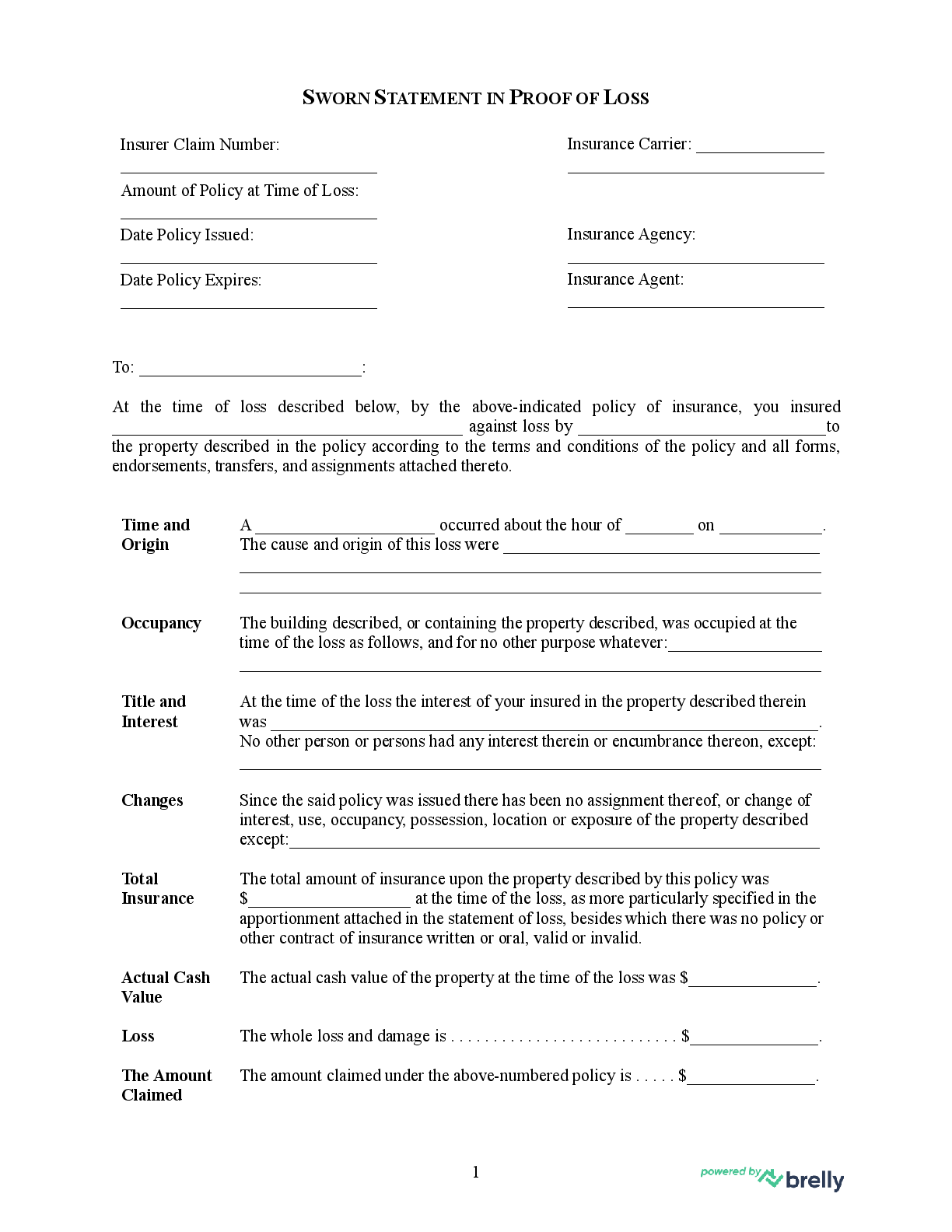 Free Proof-of-Loss FormA sworn statement in proof of loss -- often just called a Proof of Loss or POL -- is a signed document that you.....
 Homeowners: 5 Things To Do After A Property LossYou can feel overwhelmed and stressed after a property loss, but the first steps are easy. Take a deep breath. You’ll have time for.....
Brelly’s tools and resources are your secret weapon to getting your insurance claim filed right, moving fast, and paid fully.